Fleet Utilisation Reporting
What to measure — and how to act on the data.
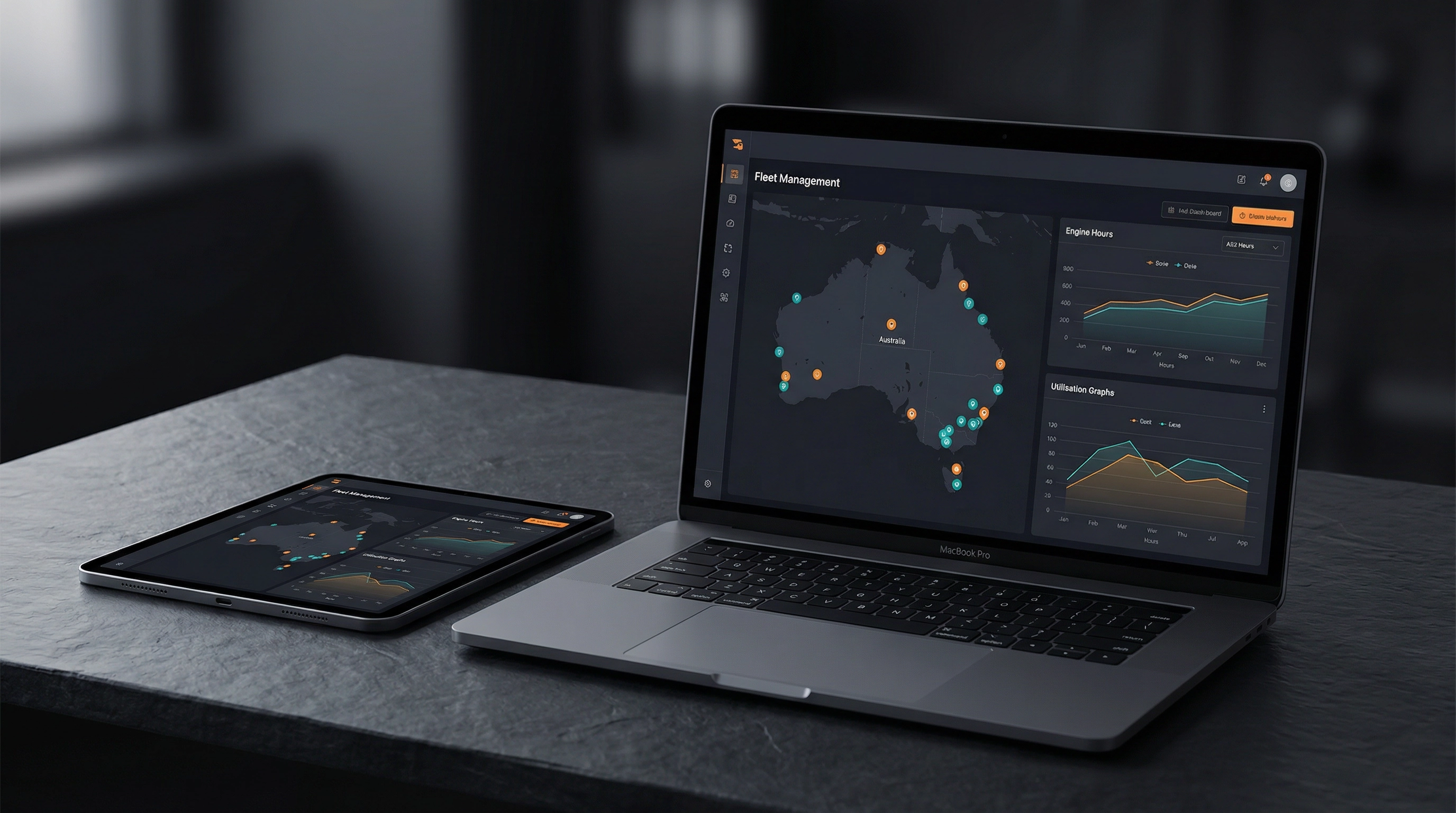
Fleet utilisation data is one of the most powerful tools available to heavy machinery operators — but only if you know what to measure and how to act on the data. Many operators have access to utilisation reports but don't know how to interpret them or what actions to take.
This guide covers the key utilisation metrics for heavy machinery, industry benchmarks, and a practical framework for acting on the data.
The Key Utilisation Metrics
1. Productive Hours
Productive hours are the hours a machine is working — engine running, load factor above a threshold (typically 30–40%). This is the most important utilisation metric: it tells you how much work your machine is actually doing.
Productive hours require CAN bus telematics to measure accurately. GPS-only trackers can't distinguish between a machine that's working and a machine that's idling.
2. Idle Hours
Idle hours are the hours a machine's engine is running but the machine is not working — low RPM, low load factor. Idle time is a direct cost (fuel) and an indirect cost (unnecessary engine wear).
Industry benchmark for idle time is 15–20% of total engine hours. If your fleet is averaging 30–40%, there's significant room for improvement.
3. Availability
Availability is the percentage of scheduled working hours that a machine is available for work — not in maintenance, repair, or waiting for parts. Industry benchmark for heavy machinery availability is 85–90%.
4. Utilisation Rate
Utilisation rate is productive hours as a percentage of available hours. A machine that's available for 200 hours per month but only works 100 productive hours has a 50% utilisation rate.
How to Read a Utilisation Report
A good utilisation report shows, for each machine over a selected period:
- ✓Total engine hours
- ✓Productive hours and percentage
- ✓Idle hours and percentage
- ✓Fuel consumption (total and per productive hour)
- ✓Fault codes logged
- ✓Service status
Sort the report by utilisation rate — lowest to highest. The machines at the bottom of the list are your underutilised assets. The machines at the top are your highest-performing assets.
Acting on Utilisation Data
Underutilised Assets
Machines with consistently low utilisation rates (below 40%) are candidates for redeployment to higher-demand projects, hire-out to generate revenue, or disposal to reduce fleet costs. The data gives you the evidence to make these decisions confidently — rather than relying on anecdotal feedback from site supervisors.
High Idle Time
Machines with high idle time (above 25%) are candidates for an idle time reduction programme — operator coaching, policy implementation, and progress tracking. See our guide on How to Reduce Idle Time on Heavy Machinery for a practical framework.
Overutilised Assets
Machines with consistently high utilisation rates (above 85%) may be approaching their service intervals faster than expected, accumulating wear faster than planned, and creating a bottleneck if they go down for maintenance. These machines are candidates for fleet expansion or more frequent maintenance checks.
Reporting Cadence
For most operations, a weekly utilisation report is the right cadence — frequent enough to catch issues early, but not so frequent that it creates noise. Monthly reports are useful for trend analysis and fleet planning decisions.
Pacific Fleet Systems provides automated weekly and monthly utilisation reports — delivered by email to your fleet manager, project managers, and site supervisors. No manual data extraction required.
Get Started
See it working on your fleet.
Book a 15-minute demo. No commitment, no sales pressure — just live data from your asset types.